Track what your people published, never forget where it came from.
Is it for me
PubDex is a publication database for any kind of research group, with the tooling to keep it up to date with minimal effort. It works at any size, and it earns its keep where people from different fields publish together: a cluster, a collaborative research centre, a graduate school, a Max Planck department. PubDex draws on every source at once, so the record comes together however widely your members publish.
Any group that publishes together
From a single lab to a whole cluster. The work lands wherever it fits: journals, conferences, preprint servers, data repositories. PubDex gathers all of it into one record of who published what.
Whoever needs the list
Proposal deadlines, annual reports, evaluations, a website. Every entry carries its source and the reason it is in or out, so the list holds up when someone asks, and still holds a year later.
Whoever runs the service
A PostgreSQL database with an ingestion pipeline and an API, on your own hardware. One command with Docker Compose, Helm next. One person can look after it, no team needed. And if you would rather not work it out alone: talk to us, we are glad to help with the first deployment.
How it works
01 COLLECT
- ORCID, Crossref and OpenAlex, plus DataCite, DBLP and Semantic Scholar
- The licensed indexes too, where your institution has them
- Repeatable runs that resume where they stopped
- Every connector reports what it covered and what failed
02 MATCH
- Duplicate works merged, authors resolved against your own roster
- All of it local: nothing is sent elsewhere to be matched
- Every field keeps the source it came from
03 CHECK
- Researchers can confirm, correct or flag their own entries
- Curators decide what gets applied
- Every correction keeps its before and after, who applied it and when
- Decisions are backed up and replayed, so they survive the next ingestion run and a rebuild of the database
04 REPORT
- A versioned read API with filtering and stable schemas
- Field provenance and source coverage on every response
- A plain CSV export for the forms that ask for one
IN DEVELOPMENT
Still being built with the NLnet grant: scored matches that show the evidence behind them, a review bundle each member can answer, and export profiles for institutional repositories and OpenAIRE. Tell us which source, export or way of working your group needs and it can still go into the plan.
Powered by PubDex
PubDex builds the database, not the public face of it. It collects and verifies your publication record and hands it over through its API and exports. How you present that, or whether you present it at all, is entirely up to you.
Our own site at CASCB is one example of what that can look like: an ordinary web page, powered by a PubDex database behind it. If you build your own, we would love to hear about it and are happy to show it here. Nobody has to, and PubDex works just as well without it.
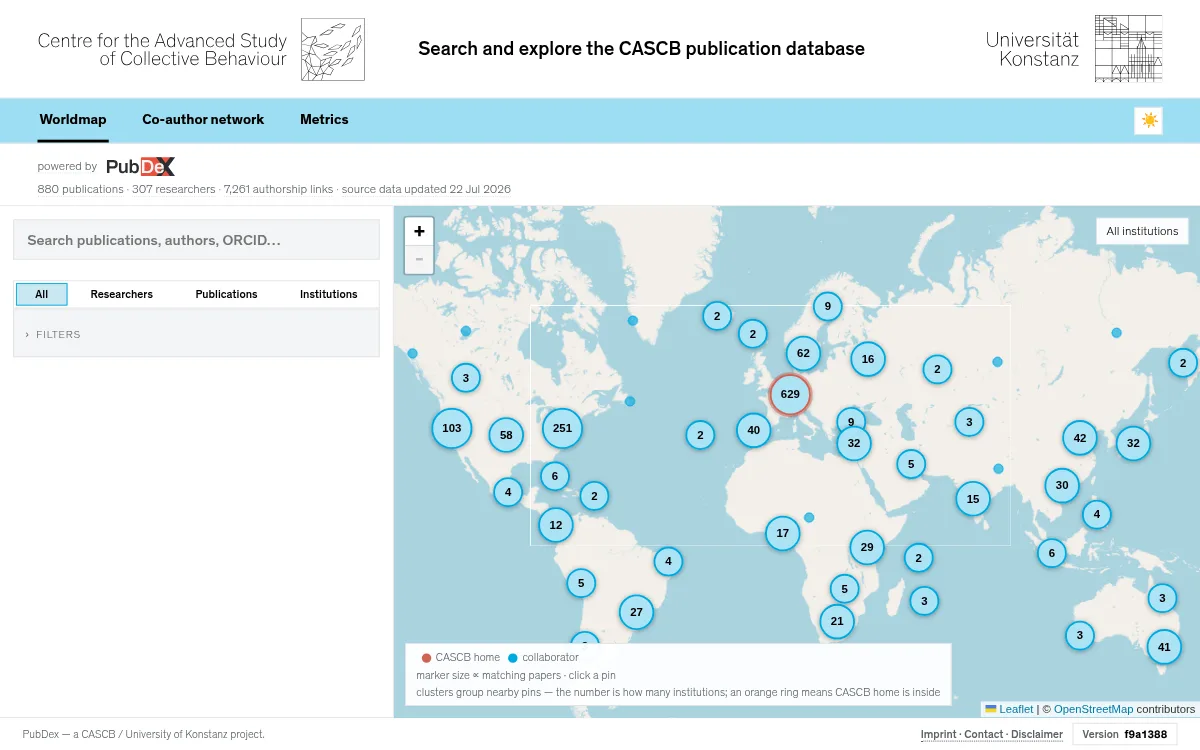
Running PubDex somewhere? Tell us and we will list your site here. A listing is a pointer and nothing more: every site is built and operated by its own institution, and we make no claim about its content, availability or compliance.
Who builds it
Deployment, pilot rollout and the feedback loop between the software and the people using it.
Ingestion and enrichment pipelines, the data model, reproducible ETL and analytical SQL.
Server provisioning, backups and monitoring.
Former OpenAIRE National Open Access Desk Germany for the EU Commission.
Open source, funded by NLnet. Read the code, file an issue, send a pull request.
Code under the MIT licence, documentation and schemas under CC-BY 4.0. No account, no paid index and no hosted service needed to run it. The repository is linked from the top of this page.
PubDex is funded through the NGI0 Commons Fund, established by NLnet with financial support from the European Commission’s Next Generation Internet programme (project 2026-02-585). It is developed at the University of Konstanz, in the Collective Computational Unit of the Centre for the Advanced Study of Collective Behaviour, which hosts the work and the first instance.